
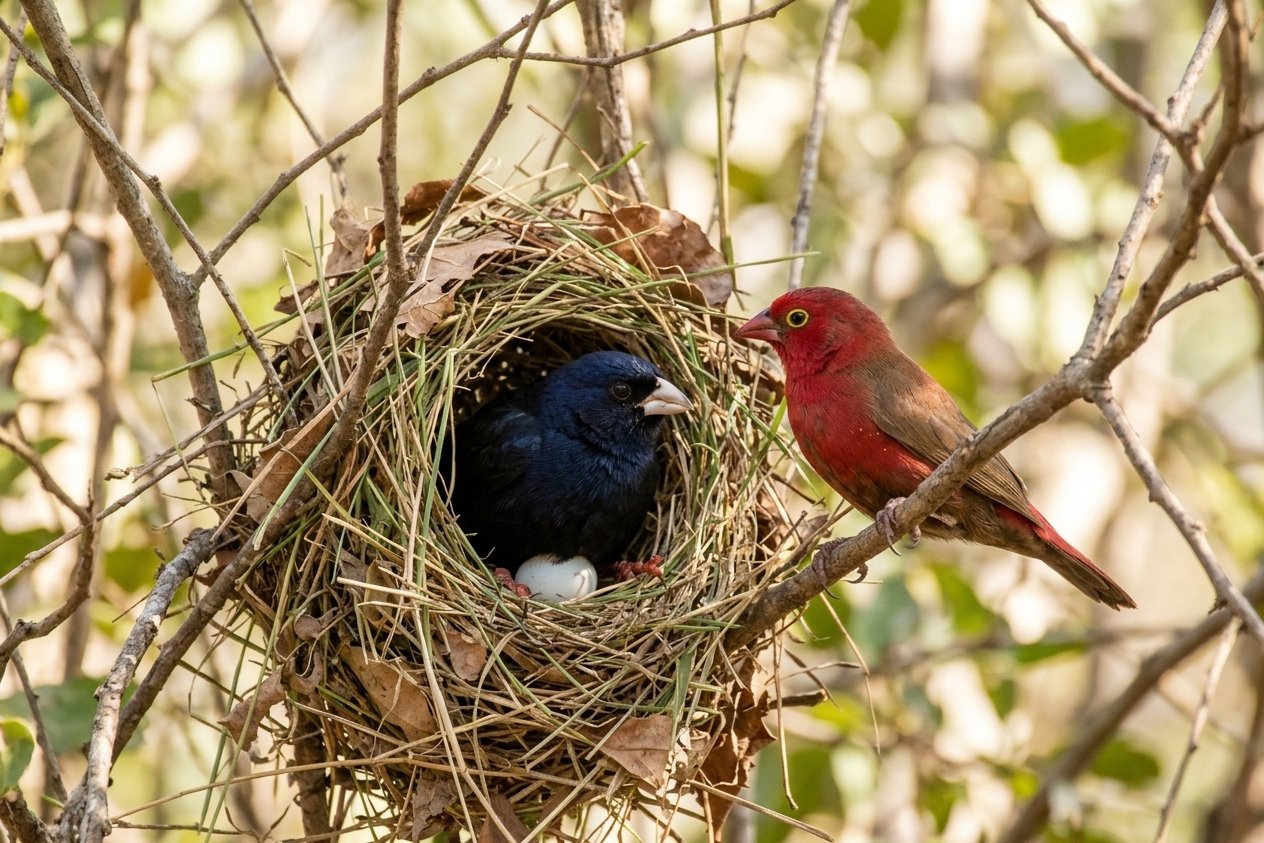
The unique relationship between Red-billed Firefinch and Village Indigobird
Nature is full of relationships in which one creature benefits at the expense of another. One of the best-known examples is the cuckoo, which lays its eggs in another bird's nest. When the cuckoo chick hatches, it often pushes the host's own eggs or chicks out of the nest. The unsuspecting foster parents then devote all their energy to raising a single cuckoo.
But in the African savanna, there is a rather different story.
The Village Indigobird (Vidua chalybeata) is also a brood parasite. It lays its eggs in the nests of the Red-billed Firefinch (Lagonosticta senegala), leaving the firefinches to raise its offspring.
Yet what happens next is quite extraordinary.
Unlike the cuckoo, the young indigobird does not eliminate its foster siblings. It grows up alongside the young firefinches, sharing the food brought by their parents. The firefinches feed and care for the indigobird just as they do their own chicks.
Even more remarkably, the firefinches seem remarkably tolerant of this arrangement. They do not normally reject the indigobird's eggs, even when the female indigobird is observed laying them in their nest.
And there may be something in it for the firefinches, too. Research has shown that parasitised nests are less likely to be abandoned during incubation. The additional egg may even encourage more consistent incubation. Although the overall number of firefinch chicks fledged is not necessarily higher, the indigobird's presence does not have the devastating consequences associated with many other brood parasites.
It is an unusual relationship: one species takes advantage of another, but without destroying its offspring. In some respects, the relationship is surprisingly close to cooperation.
A spiritual lesson: Not every relationship has to be a competition
This little story challenges some of our assumptions about relationships.
We often think in terms of competition: if somebody else gains something, I must lose something. If someone is different from me, they are a threat. If somebody enters my space and takes some of my resources, I need to defend myself.
Of course, there are situations where boundaries and protection are necessary. But nature reminds us that there are other possibilities, too.
The relationship between these two birds invites us to consider a different way of looking at others: Could their presence in my life bring something unexpected rather than simply taking something away?
As Christians, we are called to a life that goes beyond protecting our own interests. Paul writes:
"Let each of you look not only to his own interests, but also to the interests of others." — Philippians 2:4 (ESV)
And Jesus teaches us to love not only those who are like us, but also those who are different, difficult or even considered outsiders.
Perhaps the firefinch and the indigobird offer us a small illustration of this principle: A relationship does not have to be based on sameness to be fruitful. Difference does not always have to lead to conflict. And sharing what we have does not necessarily mean losing what matters most.
We should not romanticise nature: the indigobird is still exploiting the firefinch's parental care. But perhaps that makes the example even more interesting. Even in an imperfect relationship, there can be room for coexistence, unexpected benefits and a surprising degree of tolerance.
As followers of Christ, we might ask ourselves:
Do we instinctively see others as competitors and threats, or can we learn to make room for others and discover what God might bring about through our relationships?
Scientific background: Robert B. Payne's studies of indigobirds and firefinches, particularly his research on their breeding behaviour and the effects of parasitism.
Note: The image was generated by an AI. In real life, it would be very difficult to get such a shot!